
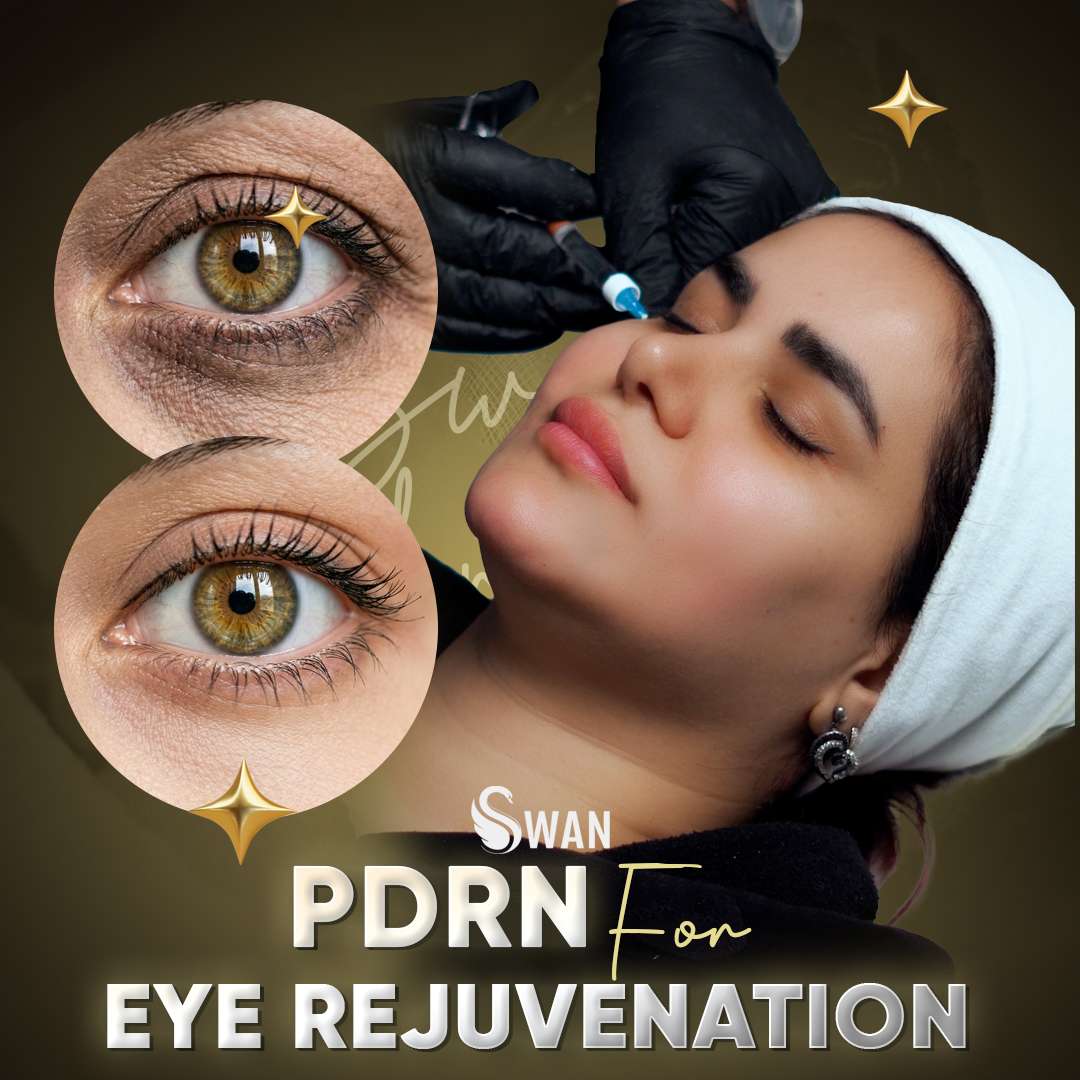
PDRN for Eye Rejuvenation – What It Is and What It Does
There is a specific kind of tiredness that settles around the eyes and refuses to leave. Not the kind that a good night’s sleep resolves, but the kind that has become a permanent feature — a darkness, a thinness to the skin, fine lines that seem to deepen regardless of what is applied to them. For many people, this is the first place the face begins to show its age, and often the hardest to address.
PDRN has become one of the more trusted clinical responses to this concern. It is not a filler, it is not a surface treatment, and it is not a quick fix. It is a biological compound that works with the skin’s own repair mechanisms to improve the quality of the tissue around the eye from within — and for clients in Dubai dealing with the compounded effects of UV exposure, dehydration, and a demanding lifestyle on already-delicate skin, it is worth understanding in detail.
What PDRN Is
PDRN stands for Polydeoxyribonucleotide. It is derived from DNA fragments extracted from salmon cells — a source chosen specifically because salmon DNA carries a molecular structure that is remarkably similar to human DNA. This biological compatibility is what makes the compound effective at a cellular level rather than simply at the surface.
When introduced into the skin through fine injection, PDRN binds to adenosine receptors in the tissue and activates the body’s own regenerative processes. It stimulates fibroblasts — the cells responsible for producing collagen and elastin — to increase their output. It improves local microcirculation, reducing the stagnation that contributes to dark discolouration beneath the eyes. It has anti-inflammatory properties that calm reactive or sensitised tissue. And it supports the skin’s capacity to retain moisture at a deeper level than topical hydration can reach.
The result is not added volume. It is improved tissue — firmer, better hydrated, more even in tone, and more resilient to the environmental pressures that caused the deterioration in the first place.
How It Differs from Filler
This is the question that comes up most often, and the distinction is important. Hyaluronic acid filler works by physically occupying space beneath the skin. It is placed into areas where volume has been lost, lifting and filling from below to reduce the appearance of hollowness and shadow. It works immediately and the result is visible from the moment of treatment.
PDRN works differently at every level. It does not add volume — it improves the quality and function of the existing tissue. Where filler compensates for what the skin has lost, PDRN encourages the skin to rebuild what it has lost on its own terms. The two treatments address different aspects of under-eye ageing, and in many cases they complement each other within a broader treatment plan rather than competing as alternatives.
For clients whose under-eye concern is primarily one of volume loss — a deep hollow or significant shadowing caused by tissue recession — filler may be the more immediately appropriate starting point. For clients whose concern is skin quality — thinness, crepiness, persistent darkness, fine lines, and a generally fatigued appearance that is not simply the result of hollow space — PDRN addresses the underlying biology more directly. Swan’s under-eye booster treatments offer a personalised approach to the periorbital area, and a consultation will clarify which treatment or combination is most suited to a given client’s specific presentation.
Why the Under-Eye Area Responds Well to PDRN
The skin around the eye is the thinnest on the face — considerably thinner than on the cheeks, forehead, or neck. This makes it particularly vulnerable to the factors that accelerate skin ageing: UV damage, dehydration, inflammation, and the gradual decline in collagen production that begins in the mid-twenties and continues steadily thereafter.
In Dubai’s environment, these pressures are intensified. Year-round UV exposure at high intensity accelerates melanin production in the periorbital skin, deepening the appearance of dark circles and increasing pigmentation. Chronic dehydration — a predictable consequence of spending time between outdoor heat and heavily air-conditioned interiors — depletes the moisture levels in tissue that is already thin and fragile. The cumulative result is an under-eye area that looks hollowed, shadowed, and older than the rest of the face.
PDRN’s regenerative, anti-inflammatory, and hydration-supporting properties address several of these drivers at once. By improving circulation beneath the eye, it reduces the vascular component of dark circles. By stimulating collagen production, it gradually thickens and firms tissue that has become thin and crepe-like. By calming inflammation, it reduces the pigmentation that reactive skin produces in response to UV stress. And by supporting deep hydration, it restores a plumpness and reflectivity to the skin that no topical product can replicate with the same consistency.
The Treatment Experience
PDRN for eye rejuvenation is administered through fine injections into the periorbital skin — the delicate tissue directly beneath and around the eye. The treatment requires precise technique and a detailed understanding of the anatomy of this zone. At Swan Aesthetic Clinic, sessions are performed by qualified practitioners who assess the client’s specific under-eye presentation before determining the most appropriate injection protocol.
A typical session takes between 20 and 40 minutes. Discomfort is generally minimal given the fine gauge of the needles used, though a topical anaesthetic can be applied beforehand for clients who prefer it. Some mild redness or swelling at the injection sites is normal immediately after treatment and typically resolves within a few hours.
Unlike filler, PDRN results are not immediate. The treatment initiates a biological process, and that process unfolds over time. Most clients notice an initial improvement in skin quality and brightness within one to two weeks of their first session. The full benefit of a treatment course — improved firmness, reduced dark circles, smoother texture, and a more rested overall appearance — typically becomes apparent over four to eight weeks as collagen production builds.
How Many Sessions Are Needed
A single session of PDRN will produce a noticeable improvement, but a course of treatments delivers meaningfully better and longer-lasting results. For most clients, a course of three to four sessions spaced two to four weeks apart is recommended as the foundation, after which maintenance sessions every three to six months help sustain the outcome.
The exact protocol depends on the individual’s skin condition, age, the degree of change being sought, and how the skin responds to the initial sessions. These details are best established through a clinical assessment rather than a fixed schedule, since the periorbital area varies considerably between clients in terms of tissue quality, pigmentation type, and vascular involvement.
What Results to Expect
Clients who complete a course of PDRN treatment for eye rejuvenation typically report:
- A visible reduction in the darkness beneath the eyes, particularly where the discolouration has a vascular or inflammatory component
- Improved skin texture — less crepiness, finer surface lines, and a smoother overall appearance
- A firmer, more supported feeling to the under-eye skin
- A brighter, more rested appearance that persists between sessions rather than fading quickly
- Gradual improvement that continues to develop over several weeks after each session
It is important to approach these results with realistic expectations. PDRN will not correct significant volume loss, will not eliminate all pigmentation regardless of its cause, and will not produce the kind of immediate visible change that filler delivers. What it will do, consistently and over time, is improve the biology of the skin around the eye in a way that produces a lasting difference in how the area looks and functions.
For clients whose under-eye concerns involve both skin quality and volume loss, a combined approach — PDRN alongside a carefully placed under-eye booster or filler — often produces the most complete result. The team at Swan Aesthetic Clinic can advise on the right combination during a personal consultation.
Making the Right Choice for Your Under-Eye Concerns
The under-eye area is one of the most nuanced zones on the face to treat well. What looks like a single concern — a tired, dark, aged appearance — often has several contributing factors, each of which responds to a different treatment approach. Getting this assessment right is the difference between a result that genuinely transforms how the area looks and one that only partially addresses what is actually happening in the tissue.
At Swan Aesthetic Clinic, every under-eye treatment begins with a thorough clinical evaluation. Whether PDRN is the right starting point, part of a combined plan, or something to consider after addressing another concern first, that guidance comes from understanding each client’s skin individually — not from applying a standard protocol.
To arrange a consultation and find out whether PDRN eye rejuvenation is right for you, reach out to the team through the contact page.
Read Recent Articles

Eye Treatments
Rejuvenate Your Eyes in Dubai The eyes are often the first to reveal the signs of aging, stress, and

The Cat Eye Lift – What It Is and How It Works
There is a quality to certain faces that is difficult to name precisely. An alertness. A sharpness a

Radio Frequency Eye Treatment
Tired of looking tired? Radiofrequency (RF) therapy, a cutting-edge treatment offered at Swan Aesthe


