
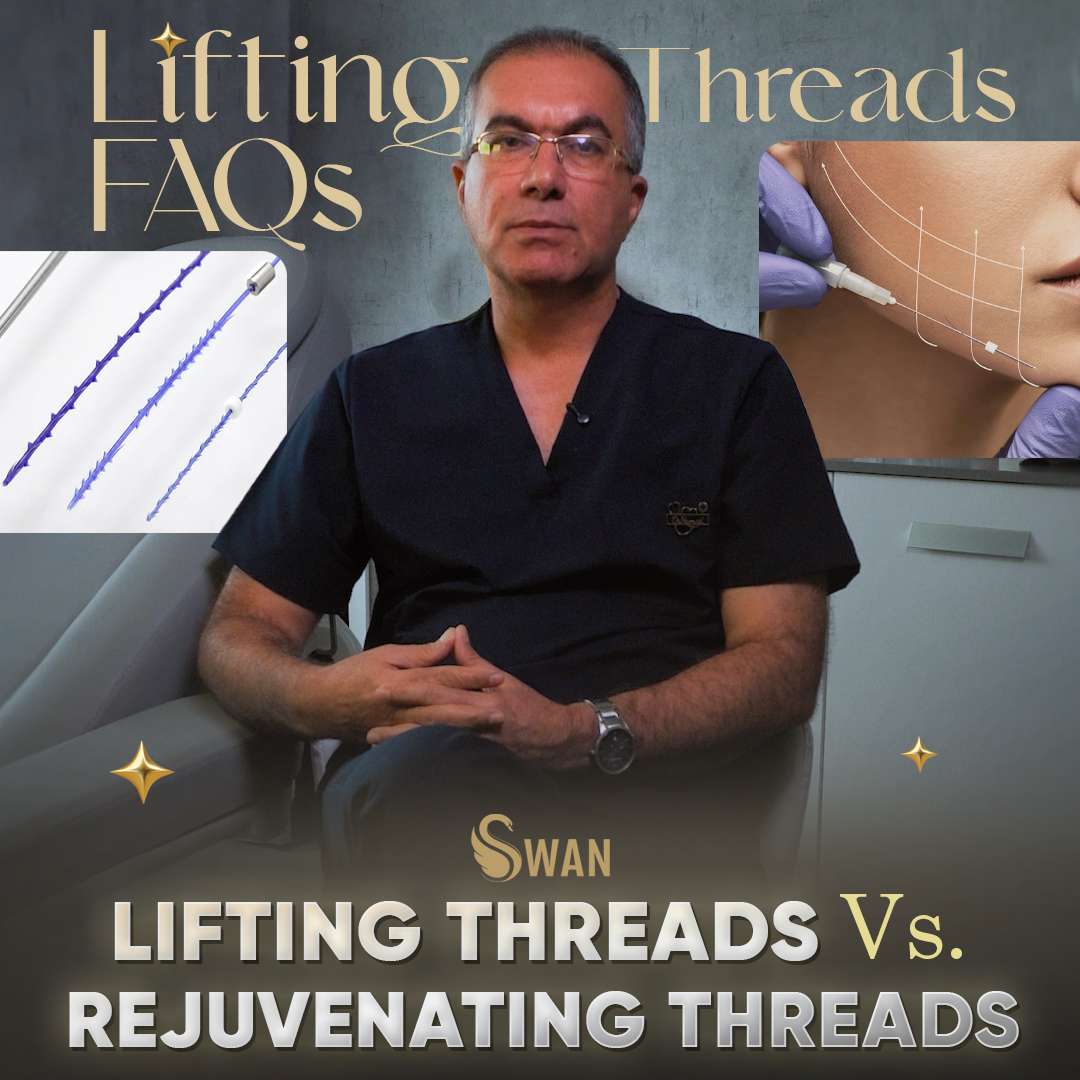
Lifting threads vs. rejuvenating threads: what’s actually happening under the skin
Not every thread placed under the skin is doing the same job. Some are there to lift. Others are there to repair. Confuse the two and you end up disappointed with results that were never designed to solve your particular concern in the first place.
At Swan, this is one of the most common points of confusion clients bring into a consultation, particularly working professionals near DIFC and Business Bay who want a clear answer before committing to anything, and brides-to-be trying to work backward from a wedding date to figure out what timeline actually makes sense.
Rejuvenating threads are fine, smooth filaments made of polydioxanone (PDO). They’re placed just beneath the surface of the skin in a grid or fan pattern, not to physically move tissue, but to trigger a healing response. The body treats the thread as a minor foreign object, sends fibroblasts to the area, and those fibroblasts get to work producing new collagen. The thread itself dissolves over several months. What stays behind is firmer, better textured skin with a very mild lift as a side effect rather than the main goal.
Lifting threads work differently. These are barbed or cogged threads, anchored deeper and positioned along the vectors where sagging actually needs correcting, typically the mid-face, jawline, or jowls. The barbs grip the tissue and physically reposition it in the direction the practitioner chooses. There’s an immediate, visible change on the day of treatment, which is different from PDO threads, where the improvement builds gradually as collagen accumulates.
Why the recovery timelines are so different
Recovery is where the distinction becomes practical rather than theoretical. Rejuvenating threads involve minimal tissue disruption, so downtime tends to run two to three days, sometimes less. Mild swelling or tenderness at the entry points is normal and settles quickly, which matters to clients trying to fit a treatment into a packed Dubai work week without visible downtime.
Lifting threads involve more mechanical work under the skin. Tissue has been grabbed, pulled, and anchored, and that process needs time to settle before the final result is visible. Recovery can extend to a few weeks, with some temporary puckering, tightness, or asymmetry as the tissue adjusts to its new position. This is a completely expected part of the process, not a sign that something has gone wrong, but it does mean lifting threads are not the treatment to schedule the week before an event.
That timing question matters more in Dubai than in most places. Between weddings, launch events, and a social calendar that rarely slows down, clients often want a treatment with a short recovery window they can plan around rather than one that requires a few quiet weeks at home. For a bride planning around a wedding date, this is exactly the kind of detail worth sorting out three to four months out, not three weeks out.
How rejuvenating threads support skin under real strain
The collagen response from PDO threads has been studied directly. Absorbable threads mechanically lift the skin immediately after implantation and continue doing so for roughly six months while the material breaks down through hydrolysis, and during that same window they stimulate new collagen formation in the surrounding tissue. A 2024 pig model study in the Journal of Cosmetic Dermatology found this collagen effect measurable well beyond the point where the thread material had already begun degrading, which is part of why the benefit outlasts the thread itself.
This kind of internal repair work is relevant specifically because of how Dubai’s environment behaves. Air conditioning strips moisture from the skin indoors, and stepping outside into UV-heavy heat undoes any hydration gained the moment before. Anyone moving between an air-conditioned office in Business Bay and a car park in August knows this transition happens dozens of times a day. The cumulative effect over months is a subtle breakdown in the skin’s own collagen reserves, long before any visible sagging shows up. Clients who add rejuvenating threads into a maintenance routine are often addressing that quiet, cumulative depletion rather than a specific sagging concern.
Where PLLA fits into the conversation
There’s a third category worth understanding, even though it isn’t technically a thread in the traditional sense. Poly-L-lactic acid, or PLLA, works on the same collagen-stimulating principle as PDO threads but is injected rather than threaded, which is why it’s sometimes informally called a “liquid thread.” Sculptra is the most established example.
Where PDO threads dissolve in months, PLLA breaks down far more slowly, and the collagen scaffold it builds tends to last longer as a result. Research comparing thread materials directly has found that PDO, PLLA, and PCL threads all support a more youthful collagen profile than no treatment at all, with the slower-absorbing materials sustaining that structural support over a longer stretch of time. For health-conscious clients who think in terms of a long-term skin investment rather than a single event, that longer arc is often the more appealing option. It’s also why some clients pair Sculptra with PDO threads rather than choosing between them.
Which one does your skin actually need?
That’s the question worth sitting with before booking anything. If the concern is texture, dullness, or the kind of fine laxity that shows up gradually rather than a defined jowl or fold, rejuvenating threads are usually the right starting point. If there’s a specific area of visible sagging with a clear direction it needs to move, that’s a mechanical problem, and a lifting thread or a technology like Endolift that tightens tissue through controlled heat is a more direct answer.
A few practical differences are worth laying out clearly before that decision gets made:
- Rejuvenating threads improve skin quality and provide a mild secondary lift; lifting threads exist specifically to reposition sagging tissue.
- Recovery from rejuvenating threads typically runs two to three days; lifting threads can require a few weeks before the final result settles.
- Rejuvenating threads last roughly a year and a half to two years as collagen production continues; lifting threads have their own separate longevity depending on thread type and placement.
- PLLA based options like Sculptra work on the same collagen principle as rejuvenating threads but are injected, not threaded, and tend to persist longer.
None of these categories are interchangeable, and none of them are automatically the “better” choice. The right one depends entirely on what the skin is actually asking for, which is exactly what a proper consultation is meant to establish rather than guess at.
What a realistic timeline looks like
Whichever category ends up being the right fit, patience is part of the process. Rejuvenating threads don’t produce a dramatic before-and-after moment. The improvement in firmness and texture builds over weeks as fibroblast activity ramps up, which is a different kind of result than the immediate repositioning a lifting thread provides on day one.
Sun protection matters more than usual in the weeks following either treatment. Given how much of daily life in Dubai involves moving between shaded interiors and direct outdoor exposure, consistent SPF and avoiding prolonged sun exposure right after treatment isn’t optional, it protects the healing tissue while collagen production is actively underway. Clients who treat aftercare as a formality tend to see slower, less consistent results than those who follow the guidance they’re given.
Aftercare guidance also extends to gentle handling of the treated area, avoiding intense workouts or facial massage for the first few days, and keeping follow-up appointments so a practitioner can track how the tissue is responding. This isn’t a treatment where more is automatically better. Overcorrecting or stacking treatments too close together tends to work against the natural process rather than accelerate it.
Choosing between rejuvenating threads, lifting threads, and PLLA options isn’t something to work out from a video or an article alone. It comes down to what your particular skin is showing signs of right now, whether that’s the early collagen loss common among busy professionals juggling Dubai’s indoor-outdoor climate shifts, or a bride mapping out a treatment plan against a fixed date, and that’s something a practitioner needs to actually see in person. A consultation at Swan starts with an honest assessment of which category actually applies to you, not an assumption based on what’s trending. Anyone weighing these options can book a consultation or browse Swan’s full range of aesthetic treatments to see how threads fit alongside the clinic’s broader approach to skin health.


