
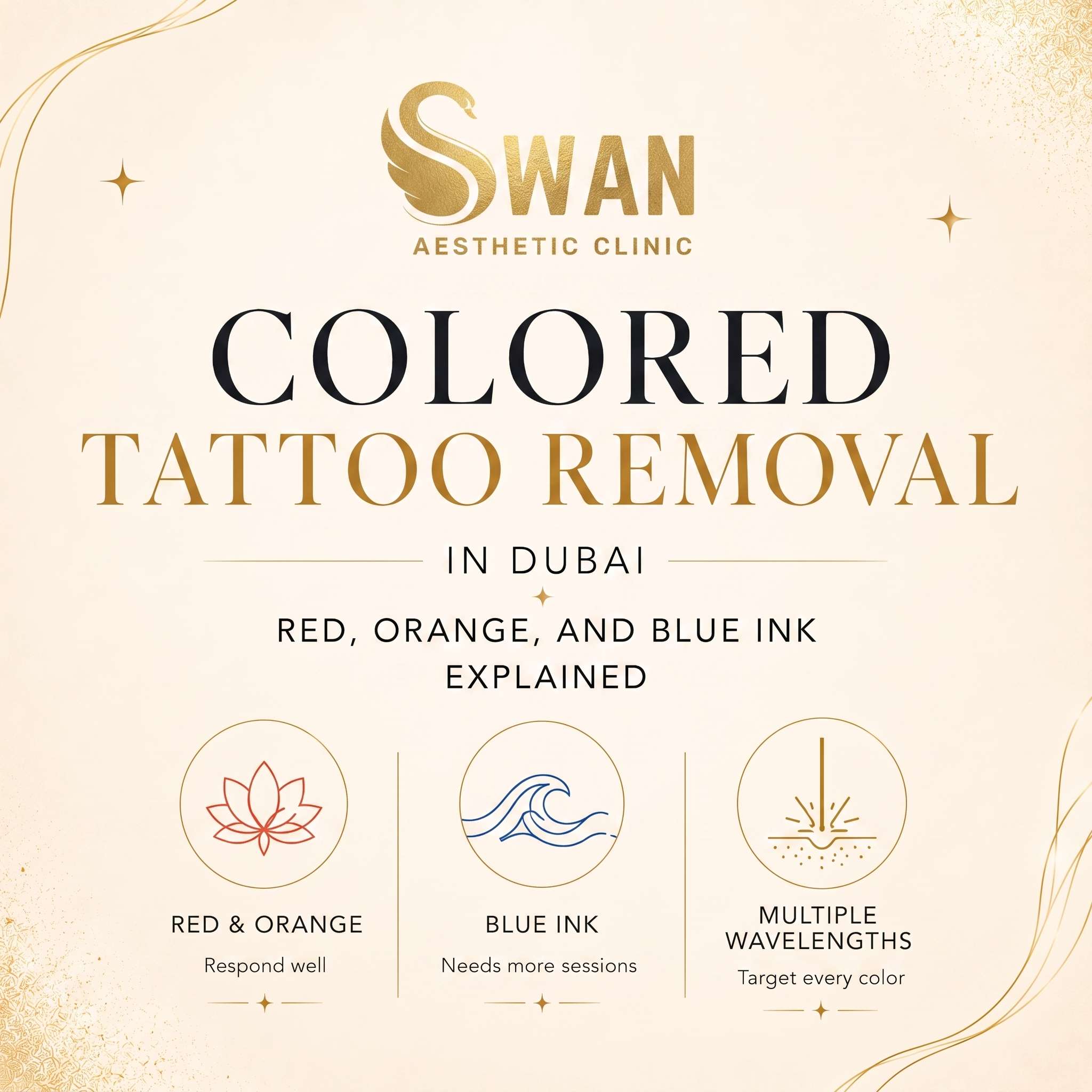
Colored Tattoo Removal in Dubai: Red, Orange, and Blue Ink Explained
Black ink fades in a fairly predictable way. Color does not. Anyone who has watched a black-and-grey tattoo clear faster than a friend’s colorful piece has already seen this play out, and the reason comes down to physics rather than luck.
Colored tattoo removal in Dubai works on the same underlying principle as black ink removal, selective photothermolysis, but the practical execution changes completely once color enters the picture. A laser wavelength only clears ink that absorbs it well. Black ink absorbs almost every wavelength, which is why it responds to nearly any laser setting. Red, orange, and blue pigments each have their own narrow absorption window, and missing that window means the ink barely reacts at all.
Why the same laser cannot treat every color
At Swan Aesthetic Clinic, tattoo removal runs on the Quanta System G1, known in clinic as the Chrome laser, which operates across multiple wavelengths including 1064 QS and 532. That range exists specifically because no single wavelength clears every pigment. A clinical study on multi-color tattoo removal found that black ink responded best to 1064 nm treatment, while red and yellow pigments cleared more effectively under a 532 nm setting. Blue and green tones needed a longer wavelength again to respond well.
This is why a multicolored tattoo is never really one treatment. It is several treatments layered onto the same skin, spaced out so each wavelength gets its turn without overworking the area in between.
How each color behaves under the laser
Red and orange ink tend to respond fairly well once the correct wavelength is applied, since these warmer tones absorb green light efficiently. Blue presents more of a challenge. It sits at a wavelength that overlaps less cleanly with the settings that clear black ink, so blue portions of a tattoo often take longer and need more sessions relative to the black outline surrounding them.
Does that mean colored tattoos always take longer to remove than black ones? Generally yes, though density and depth still matter more than color alone. A lightly saturated red design can clear faster than a densely packed black one. Color shifts the difficulty, but it does not override everything else about how the tattoo was made.
A few practical points come up often enough in consultations that they are worth setting out clearly before a colored tattoo removal plan takes shape.
Multiple wavelengths mean multiple passes. A single session may involve more than one laser setting to address different colors within the same tattoo.
Blue and green areas often need extra sessions. Building this into the plan from the start avoids disappointment partway through.
Test spots help calibrate settings. A small treated area early on gives a practitioner real information about how the specific ink responds, rather than relying on assumptions.
Fading is uneven before it is complete. Some colors visibly lighten faster than others, and that unevenness is normal mid-treatment, not a sign something has gone wrong.
None of this changes the end goal. It just means the path to get there looks a little different depending on what colors are involved, and understanding that upfront makes the process far less confusing to live through.
Dubai’s climate adds another layer to color-specific treatment
Skin that carries any tan complicates laser settings regardless of ink color, but the risk is more pronounced with certain wavelengths used for warmer tones. If the treatment area shows any sun exposure, a session gets postponed rather than pushed ahead at reduced settings. In a city where outdoor exposure is close to constant for much of the year, that discipline around timing matters more than it would somewhere with a shorter, milder summer.
The same logic applies to spacing sessions around Dubai’s social calendar. Clients preparing for events sometimes want to compress the timeline, but rushing colored ink removal, where multiple wavelengths are already stacking demands on the same skin, tends to backfire through prolonged redness or uneven clearance rather than faster results.
What a realistic plan looks like
A consultation for colored tattoo removal typically starts by mapping which colors are present and where they sit relative to each other. Overlapping colors, like a blue outline shading into a green fill, need careful sequencing so one wavelength does not undermine progress made by another. Clients sometimes pair this process with skin booster treatments to support skin resilience across a longer, multi-wavelength plan, and that is worth raising at the first visit if skin recovery is already a concern.
For anyone weighing colored tattoo removal against other laser-based treatments in the same season, such as laser hair removal, spacing both around the same skin needs coordination rather than guesswork.
Getting the wavelength right at Swan Aesthetic Clinic Dubai
Removing a colorful tattoo is rarely a single-wavelength job, and clinics that treat every color the same way tend to produce uneven, disappointing results. What actually works is matching each pigment to the setting it responds to, sequencing sessions so no color gets shortchanged, and giving the skin time to recover between the different wavelengths involved.
Anyone with a multicolored tattoo who wants an honest read on what treatment looks like can reach out here and start with an assessment built around the specific colors in question.
Read Recent Articles

Tattoo Removal Aftercare in Dubai: What to do in the 48 hours after your session
The first two days after a tattoo removal session decide more about the final result than almost any

How Many Sessions does Tattoo Removal take? Dubai Patient Guide
Six is the number most people hear first, and for a good number of tattoos it holds up. For others i

Tattoo Removal Dubai: How the Quanta System G1 Laser removes all Ink Colors
A name that meant something at twenty-three does not always mean the same thing at thirty-four. That


