
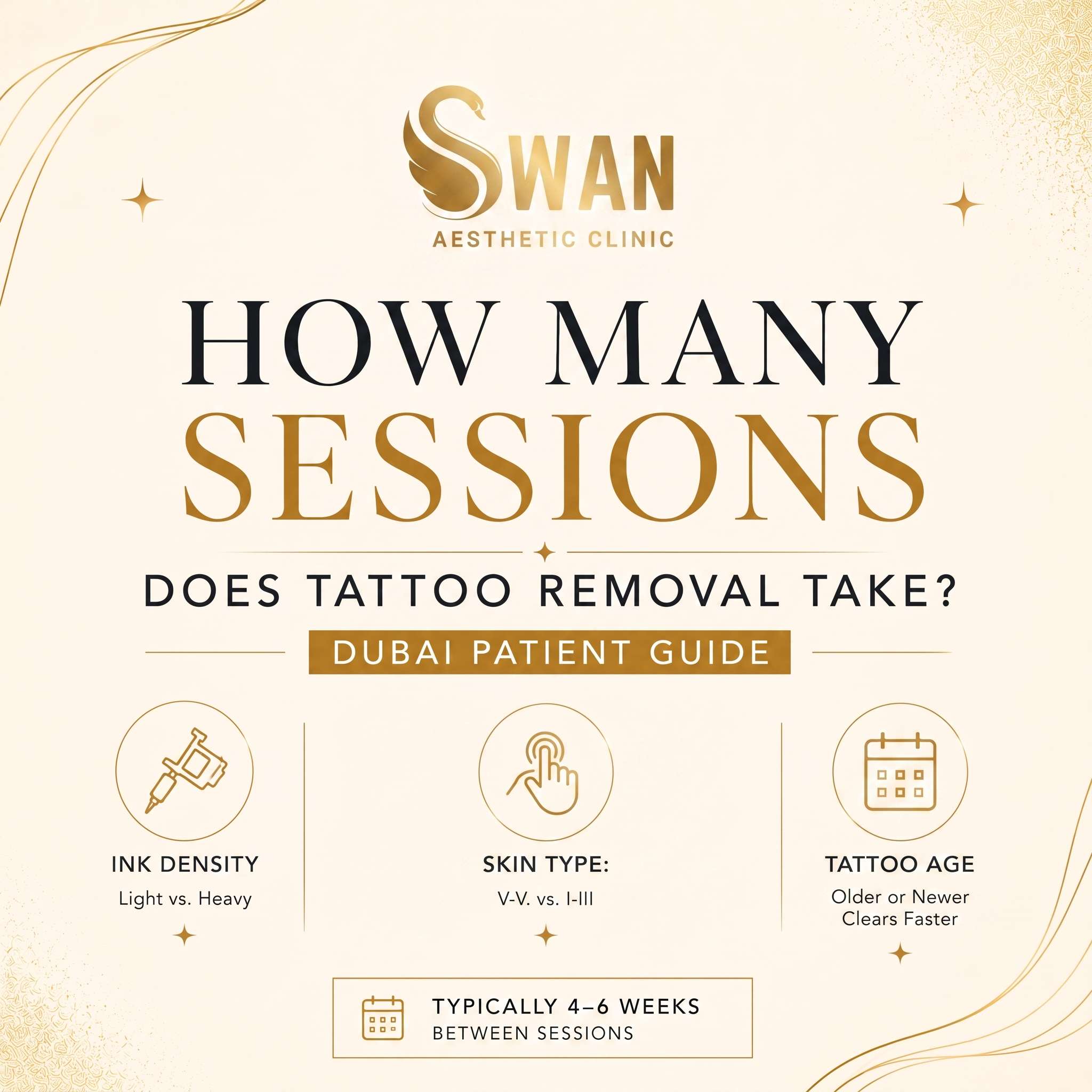
How Many Sessions does Tattoo Removal take? Dubai Patient Guide
Six is the number most people hear first, and for a good number of tattoos it holds up. For others it does not come close. The honest answer to how many tattoo removal sessions a person needs in Dubai depends on the tattoo itself far more than on anything about the person carrying it.
A 2025 study in the Journal of Cosmetic Dermatology followed 116 patients through complete black tattoo removal and found the average number of sessions was six, ranging anywhere from two to twenty depending on the individual tattoo. That range is wide enough to be almost useless as a promise, which is exactly why a proper consultation matters more than a generic estimate.
What actually decides the number
The single biggest factor, by a wide margin, is ink density. The same research found low-density tattoos needed an average of just over three sessions, while high-density tattoos needed closer to nine. Density has nothing to do with size. A small, heavily saturated design can take longer to clear than a larger but lightly shaded one.
Location on the body matters too, and the explanation is more physiological than most people expect. Areas with richer lymphatic drainage, like the upper trunk, tend to clear faster. Areas with less circulation, like the hands, fingers, and ankles, generally need more sessions to reach the same result. Tattoo age plays a role as well: very recent ink and tattoos older than five years both tend to respond faster than pieces sitting in that middle stretch of one to five years.
Does the color of the ink change the number? It does, and this is where the Quanta System G1, branded in clinic as the Chrome laser, becomes relevant. Chrome runs across multiple wavelengths, including 1064 QS and 532, so black and dark blue ink respond to one setting while reds, oranges, and purples need a different one entirely. A tattoo with several colors is not one removal process. It is several running in parallel, on the same skin, spaced to give each wavelength room to do its job without overworking the area.
Spacing sessions the way Dubai’s climate demands
Sessions are typically spaced four to six weeks apart, and that interval is not arbitrary. It gives the body’s lymphatic system time to clear fragmented ink between appointments, and it gives the skin time to recover from the surface reaction that follows treatment.
In Dubai, that spacing has to work around something most clinics elsewhere never think about: near-constant UV exposure. If the treated area is visibly tanned on the day of a session, it gets postponed. Treating sun-affected skin raises the risk of uneven pigment response, and pushing ahead anyway usually costs more sessions in the long run, not fewer. For residents whose routine includes regular outdoor time, whether that’s a weekend at the beach or simply the commute between air-conditioned buildings and open parking lots, factoring sun protection into the treatment calendar is not optional. It is part of what keeps the total session count from creeping upward.
What actually happens between appointments
The gap between sessions is not passive waiting. A few things during that window genuinely affect how the next appointment goes, and skipping them tends to show up as a session added onto the total rather than saved.
- Sun protection over the treated area. Broad-spectrum SPF, every day, not just on outdoor days, protects skin that is actively healing pigment changes underneath.
- No picking at the surface reaction. Mild blistering, redness, or crusting is normal and resolves faster when left alone.
- Avoiding other laser treatments on the same area. Combining tattoo removal with other laser work too close together stresses skin that is already doing repair work.
- Following the specific interval given at consultation. Four weeks for one tattoo might be too soon for another, depending on how the skin responded to the last session.
None of these steps shorten a stubborn removal into a fast one. What they do is prevent the treatment from taking longer than the tattoo’s own characteristics already require.
Setting a realistic timeline before the first session
The most useful thing a consultation does is turn an abstract range into something specific. A practitioner assessing ink density, color composition, location, and the tattoo’s age can give a far more grounded estimate than any number pulled from a general guide, including this one. Some clients also start considering skin booster treatments alongside removal, particularly if they want extra support for skin resilience across a longer treatment plan, and that conversation is worth raising at the same visit.
Clients weighing removal against a full laser hair removal program in the same season should mention that too, since scheduling both around Dubai’s UV patterns takes some coordination.
Getting a number that means something
A range from two sessions to twenty is not a plan. It is a reminder that tattoo removal resists shortcuts, and that the clinics offering a confident number before seeing the tattoo are usually guessing.
At Swan Aesthetic Clinic Dubai, that number comes from an actual look at the ink, not a generic average. Anyone ready to find out what their own timeline looks like can get in touch here and start with an honest assessment instead of a guess.
Read Recent Articles
Colored Tattoo Removal in Dubai: Red, Orange, and Blue Ink Explained
Black ink fades in a fairly predictable way. Color does not. Anyone who has watched a black-and-grey
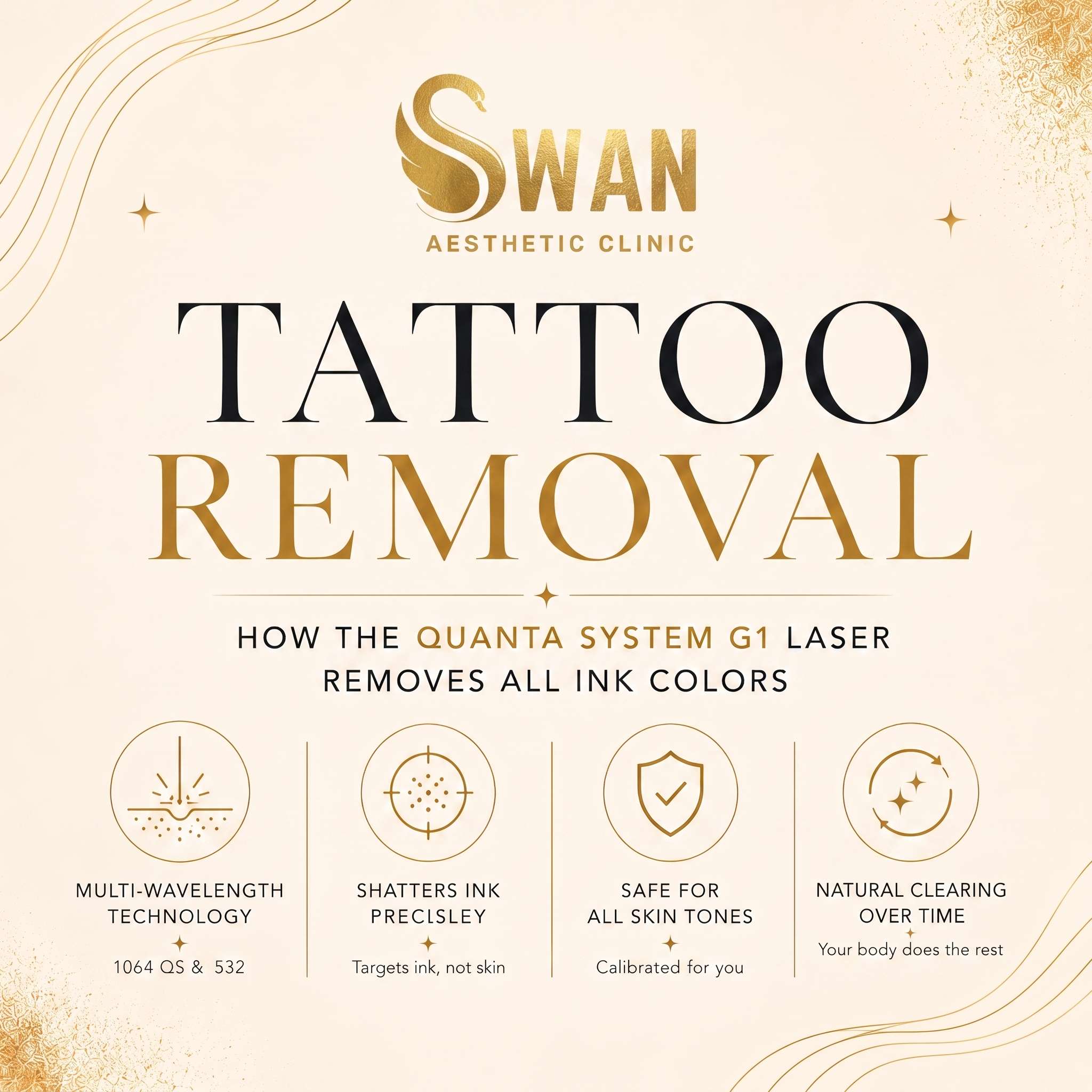
Tattoo Removal Dubai: How the Quanta System G1 Laser removes all Ink Colors
A name that meant something at twenty-three does not always mean the same thing at thirty-four. That

Tattoo Removal Aftercare in Dubai: What to do in the 48 hours after your session
The first two days after a tattoo removal session decide more about the final result than almost any


