
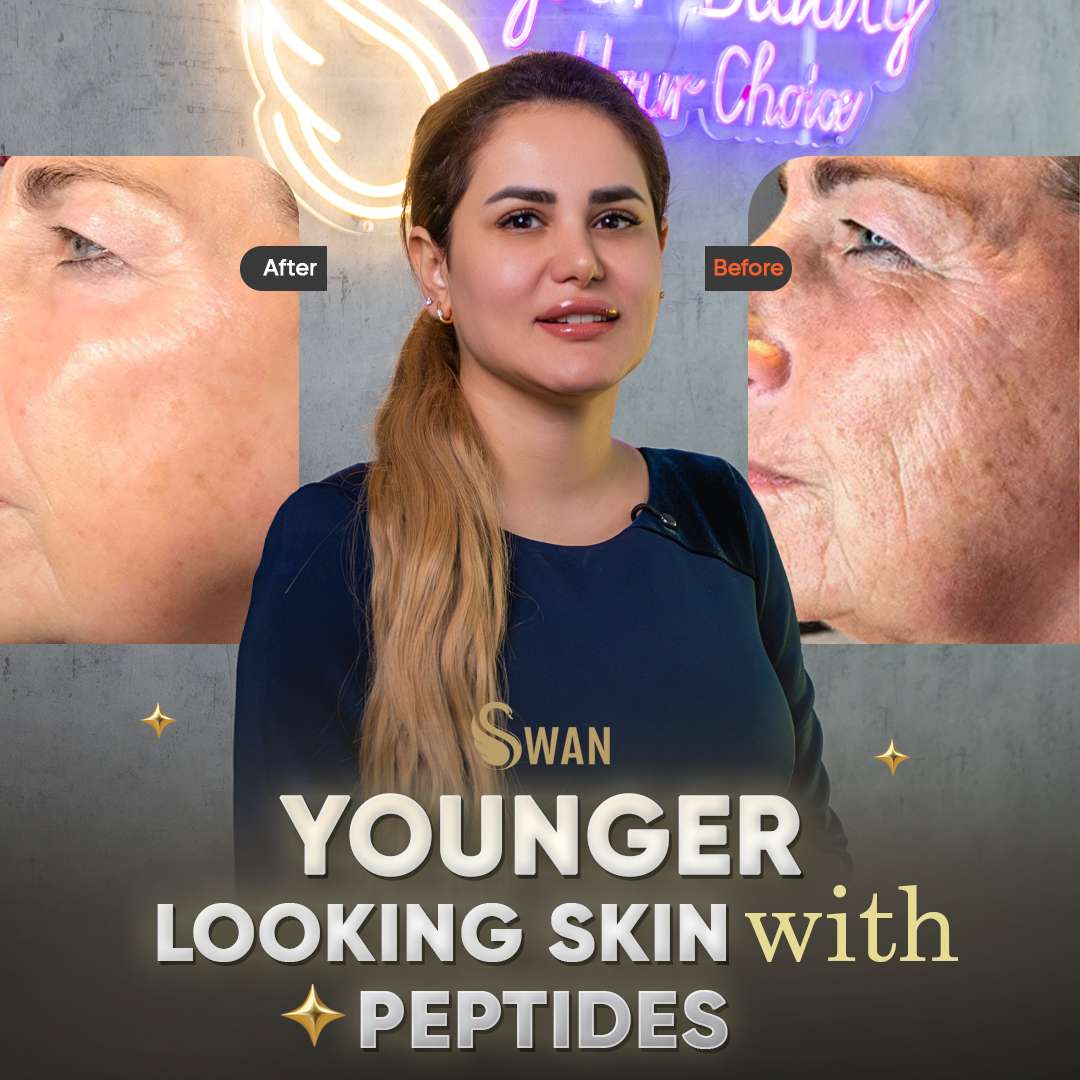
Younger Looking Skin with Peptides in Dubai – Peptide Facials for Skin Repair
Anti-aging skincare has no shortage of ingredients promising more than they deliver. Peptides are one of the few that have actual research behind them, which is worth separating from the marketing noise around the word.
What a peptide actually is
A peptide is a short chain of amino acids, the same building blocks that make up the proteins your skin is built from. Certain peptides act as signaling molecules, essentially instructing skin cells to behave the way they did earlier in life: producing more collagen, repairing damaged tissue, and rebuilding structure rather than simply sitting on the surface as a moisturizing layer would. Copper peptide compounds, most notably one known in research as GHK-Cu, are among the most studied of these, with decades of published work on their role in wound healing and tissue remodeling.
This matters because the skincare industry uses “peptide” loosely, often as a label on products with negligible concentrations doing very little. A clinical, in-office peptide treatment works differently, and understanding that difference is the actual point.
Why delivery method changes everything
A peptide serum applied to the surface of the skin faces a real obstacle: skin is designed to keep things out, not let them in. This is where microneedling comes in. Creating a series of microscopic channels in the skin allows a peptide formulation to reach deeper layers than a topical product could manage on its own. A 2024 review examining topical GHK application noted that permeation remains a genuine challenge for this class of peptide, and that pretreating skin, including with microneedling, has real potential to improve how effectively it penetrates. In other words, the delivery method isn’t incidental. It’s often the difference between a treatment that reaches the tissue it’s meant to affect and one that doesn’t.
What the session actually feels like
This tends to be one of the first questions clients ask, understandably. The treatment uses fine needling to create those micro-channels, and while that sounds intense on paper, topical numbing is typically applied beforehand, and most clients describe the sensation as mild pressure rather than pain. There’s no meaningful downtime afterward. Clients can return to normal activity the same day, though some temporary redness in the treated area is common and usually settles within a day.
Prevention versus repair: two different reasons to book this
Clients tend to approach this treatment from one of two directions, and both are legitimate reasons to book it.
- Clients around age 35 and older who haven’t yet developed significant visible aging but want to support collagen production before decline becomes noticeable, treating this as a preventive step rather than a corrective one.
- Clients already noticing fine lines, dullness, or reduced skin firmness who want a treatment that actively supports the skin’s own repair mechanisms rather than masking the concern temporarily.
Neither group should expect an overnight transformation. What both groups are doing, in different ways, is giving the skin better tools to maintain and rebuild its own structure over time.
Setting realistic expectations on timing
Peptide-based skin treatments work with your biology, not against it, and biological processes take time. Collagen remodeling unfolds over weeks, not days, and most clients see gradual improvement in skin texture, firmness, and tone rather than a single dramatic before-and-after. This is consistent with how the research on copper peptides describes their effect: cumulative rather than immediate, building most noticeably with a course of sessions spaced appropriately rather than a single visit.
Is one treatment worth doing on its own? It can offer some benefit, particularly for the skin’s short-term recovery and texture. But clients seeking meaningful, lasting change in firmness and fine lines typically need a series of sessions, spaced a few weeks apart, to give the skin time to respond and rebuild between treatments.
Why this fits so naturally into life in Dubai
Collagen decline doesn’t happen in a vacuum, and Dubai’s climate accelerates it more than most places. Intense, near year-round UV exposure breaks down existing collagen faster than in cooler climates, while the constant shift between air-conditioned interiors and outdoor heat leaves skin chronically dehydrated in a way that makes early aging more visible sooner. For professionals moving between meetings in Business Bay and evening plans the same day, a treatment requiring essentially no recovery time fits naturally into a schedule that doesn’t have room for anything else.
There’s also a practical reason prevention-focused treatments have grown more popular here specifically. Clients in their mid-thirties are often the first to notice how much faster skin ages under constant sun exposure compared to friends or family living elsewhere, which tends to shift the conversation from reactive to preventive earlier than it might in a milder climate.
Aftercare that actually supports the result
Sun protection matters more after this treatment than at almost any other point, since the skin’s barrier is temporarily more permeable following microneedling. Diligent SPF use in the days following treatment isn’t optional if the goal is to protect the collagen-building process rather than undo it. Staying well hydrated supports the same repair mechanisms the treatment is designed to activate, and avoiding harsh actives, such as retinol or strong acids, for a few days afterward gives the skin room to recover without added irritation.
Getting a clear plan at Swan Aesthetic Clinic Dubai
Peptide-based skin treatments work best as part of a properly sequenced plan rather than a one-off booking, and that plan should reflect whether a client is treating existing concerns or working preventively. Clients can review Swan’s approach to microneedling treatments as a starting point, including how it’s often paired with PRP therapy for clients seeking a more intensive regenerative approach. For those specifically interested in collagen-focused skin boosters as part of a broader plan, Swan’s full skin booster range is worth reviewing alongside a peptide-based protocol.
The right combination and session count depends entirely on individual skin condition, which is why a proper consultation matters more here than with most treatments. Clients ready to map that out can reach the team through Swan’s contact page to book an assessment.
Read Recent Articles

Peptide Therapy for Weight Loss in Dubai: What GLP-1 treatment at Swan actually involves
Diet and exercise plateau for a lot of people, not because they’ve stopped trying, but because


